
INTERVIEW: Elaine Walker Builds an Alien Musical Universe in “MACROCHIP”
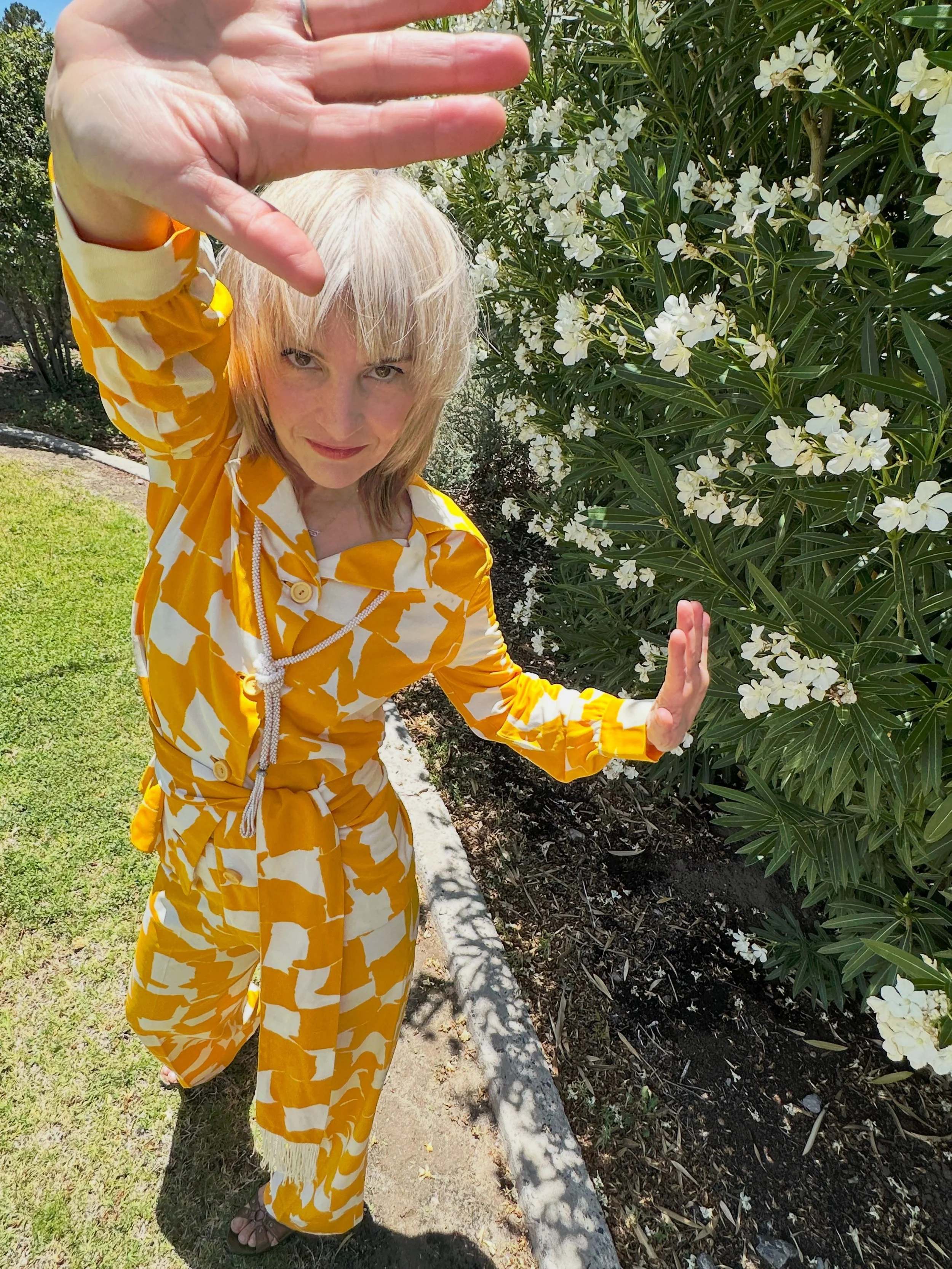
Elaine Walker’s career has developed at an unusual intersection of music, mathematics, technology, and scientific exploration. Her interest in synthesizers began during her teenage years, but it was her encounter with the Bohlen–Pierce scale at Berklee College of Music that ultimately defined her path. Since then, she has explored macrotonal composition, designed new musical instruments, and incorporated ideas related to physics, space, artificial intelligence, and mathematical systems into her creative language.
All these interests converge in “MACROCHIP,” an album consisting of eight five-minute instrumental pieces that Walker calls “Synema Songs.” In each one, the music and visual narrative are developed simultaneously until they function as a single work. Robots, astronauts, aliens, and alternate realities inhabit these miniature science-fiction films, created with human-made stock footage and connected by the sound of the Bohlen–Pierce scale. Beneath its retrofuturistic aesthetic, the project explores survival, friendship, identity, and consciousness from an optimistic perspective, while using the extraterrestrial to speak about deeply human experiences.
In conversation, Walker explains how this universe took shape and reflects on the role that alternative tuning, science fiction, and creative limitations played in its creation.
Elaine, tell us a little about yourself. How did your relationship with music begin, and what experiences led you to develop a career in which mathematics, technology, and scientific exploration also converge?
Like many here, my brother and I were born musicians. Mom played a lot of piano when we were in the womb, so it was baked in. I was a teen in the 1980s, so 80s music also got baked in! Mom also helped us get some synth keyboards when we were young teens. Dr. B at Berklee College of Music played his macrotonal music for class one day (in the Bohlen-Pierce Scale!), and I knew I had found my niche.
Around that time, the internet was a new thing, and I blasted into the future. I discovered all these groups into space travel, superlongevity, artificial intelligence, transhumanism, chaos math, and so forth. I never knew I had an interest in those things before that moment! It led me to become a space activist, physics/philosophy author, inventor of new kinds of musical instruments, and, more recently, a visual math researcher.
I don’t experience those as unrelated careers so much as different outlets for the same brain. I’ve always been fascinated by patterns and systems that operate outside familiar rules. But music is my default state, and those other topics often inspire my songs. That’s why they have such nerd titles!
For those discovering the project for the first time, what is “MACROCHIP,” and what central idea connects its eight audiovisual pieces?
MACROCHIP is an album of eight five-minute instrumental “Synema Songs.” I used licensed, human-created stock footage to make miniature science-fiction movies, developing the visual story organically with the song. Each creates its own little reality, but with recurring inhabitants such as robots, aliens, and astronauts. The album gradually became a universe of its own.
Musically, an otherworldly element ties everything together: the entire album is written in the Bohlen-Pierce scale, which is so exotic that it even replaces the idea of an octave as the frame. Yes, that means there’s only one of every note across the hearing range! So, the songs all inhabit the same slightly alien musical physics.
In fact, an early idea for the album was simply to write it entirely in the Bohlen-Pierce Scale, which is hard enough as it is. But somehow I got the harebrained idea to make them into little movies, so the whole thing became quite an undertaking.
You describe these pieces as “Synema Songs,” works in which the song and the film are conceived simultaneously. How did you arrive at this concept, and what distinguishes it from a music video or a film accompanied by a soundtrack?
I came up with the term “Synema Song” because I realized I wasn’t really making music videos, and I wasn’t scoring films either. In a conventional music video, the song generally exists first, and visuals are stitched together in an artsy way to accompany it. In a film score, the film comes first, and the music is stitched together to support it. With these, I was moving back and forth between both at once.
When I was creating MACROCHIP, my synth compositions and the little video plots organically locked together until I stopped experiencing them as music plus pictures and started thinking of each one as a single five-minute work. “Synema” is my slightly ridiculous word for that hybrid.
Each piece presents a science-fiction story featuring astronauts, robots, aliens, and alternate realities. When you began creating each one, did you usually start with a musical idea, a character, an image, or a narrative conflict?
There really wasn’t one method, which was part of the fun. The music existed in various stages, but once I started searching through footage, characters and situations would appear that I hadn’t anticipated. A single strange clip could suddenly suggest an entire plot, and then I’d start hunting for other footage that could plausibly belong to the same universe.
Roboty was particularly important because that's where I discovered how much narrative I could build from these little fragments, but I was still learning the basics, like how to layer and move things on the screen. I ended up downloading so much unused footage of Roboty and his friends that they eventually demanded a second production, Robot Psyop. By that time, I had become much more ambitious about what kind of story I thought I could construct this way.
The eight stories can stand on their own, but they are also part of a single project. What thematic or emotional elements connect them, and what kind of journey did you want audiences to experience when watching them together?
After seeing way too many apocalyptic predictions of our future, I wanted to give this mini movie album an optimistic emotional spine. The thread running through all eight stories is curiosity about the unknown and what different characters do when encountering something larger than themselves that they don’t fully understand: a mysterious force, an alien civilization, another reality, a hostile environment, a hive mind, a robot takeover, a rigged wormhole, and, finally, the hidden structure of existence itself.
It overlaps a bit with current fears of AI, robot takeover, and mind control, but they’re not grim dystopian stories. When terrible things happen, the characters are resourceful, curious, affectionate, absurd, and determined and often end up helping somebody else. I suppose the feeling I’d like people to leave with is that if and when the rules of our reality become undependable in the future, these qualities will still be rewarded.
Some of the Synema Songs involve civilization-scale existential disasters, but not all. Synchrotronic, the most impressionistic of the eight, is essentially about two people finding each other and communicating across a strange virtual reality. In Delphinity, two dolphins are taken behind the curtain of their own existence and emerge as ambassadors to the stars. The album is actually very optimistic, moving from surviving strange worlds to finally transcending one.
The entire album was composed using the Bohlen–Pierce scale, a system that divides a tritave into thirteen equal steps. For someone who has never listened to microtonal music, how would you describe the sensations this scale creates, and why was it appropriate for the universe of “MACROCHIP”?
Bohlen-Pierce can sound strangely familiar and completely alien at the same time. You can still hear melody, harmony, tension, and resolution, but the distances between the notes aren’t the ones your ears have spent a lifetime predicting.
I’ll explain briefly how it differs. Instead of the standard 12 notes that repeat at every octave (double the frequency), Bohlen-Pierce repeats 13 more widely spaced notes at every tritave (triple the frequency). For musicians reading this, a tritave sounds like an octave plus a fifth. I’ve composed so much Bohlen-Pierce scale music over the years that I've started to perceive a tritave as sounding like an octave. It’s frightening every time it happens, but still exciting.
The otherworldly vibe made it perfect for MACROCHIP. The audience is watching characters encounter unfamiliar realities, while the tuning sounds like the natural musical physics of this universe.
The project combines a retrofuturistic sound with stories about survival, friendship, identity, and consciousness. What does science fiction allow you to express about human experiences that might be more difficult to address in an everyday setting?
There’s an autobiographical reason I feel so comfortable speaking through aliens. Many autistic people describe feeling as if we’re an alien species trying to decipher rules that everyone else seems to know instinctively. I wasn’t diagnosed until my life was half over, so all that time I never understood why I felt surreal and separate or even how to articulate it. However, creative outlets came naturally to me. It’s easier for me to express something human through an alien stock-footage character than through two people having a conversation.
Science fiction gives me some distance, and I love that it lets enormous ideas and ridiculous ideas coexist. Friendship can become a rescue between worlds. Social conformity can become a robotic hive mind. Isolation can become an astronaut stranded at a wormhole. Curiosity can lead a dolphin through the backdoor of reality with an interdimensional jellyfish. You get the idea! Sometimes the alien is the easiest way to talk about the human.
I believe there are still many people like me who end up out in the world without realizing they’re autistic, especially those who have learned to adapt and appear relatively typical. It’s like being stuck in 2nd gear, revving the engine just to socialize, when everyone else is cruising in their automatic. So whenever I get a chance like this, I like to mention it. We exist!
Amid the rise of generative artificial intelligence, you decided to create the visual component exclusively with licensed, human-created stock footage. Why did you make that decision, and what do you feel it brought to the project?
It’s similar to why I enjoy composing in small-numbered temperaments, such as ten notes per octave or Bohlen-Pierce. I like to start far outside the norm, then impose more limitations. That’s when I’m most creative! If you offer me unlimited notes or tell me I can write a paragraph and instantly generate a great song and exactly the movie I want, I’m bewildered and bored before I even begin. I also just like the slightly stiff, rigid look of stock animation. At this point it feels like part of my brand.
As I searched through thousands of unrelated clips, I became obsessed with spotting As I searched through thousands of unrelated clips, I became obsessed with spotting connections between things never meant to connect. It turned into an enormous pattern-matching puzzle. That friction was a huge part of what kept the project creatively exciting for me. The fact that no one else seems to make movies this way was even more appealing.
I’d actually love to see stock-footage companies take this idea further by creating a way for musicians and filmmakers to directly commission the stock clip artists who make changes, like if we need two of their characters to appear together or with green screen. One ironic outcome of generative AI might be that people find innovative new ways to employ other humans.
I use AI for all kinds of things, just not my art. I have friends who make AI art every day and genuinely love using language to create images or music. It just isn’t my thing. I’m actually very thankful microtonal music hasn't seen an AI takeover yet. I’m enjoying this little island while it lasts.
What do you hope to achieve with this creation?
I hope people have fun with it first. I hope to achieve many 40-minute viewing parties around the world. There are plenty of ideas underneath MACROCHIP about technology, consciousness, other worlds, alternative musical systems, and how we imagine the future, but I don’t want anyone to feel they need to understand Bohlen-Pierce tuning or fully understand the stories to enjoy it. Each mini-movie has a basic synopsis and always a plot twist but also enough unexplained territory for friends to have existential arguments. That’s part of the fun!
If you’re a loner like me, watch it at home with your pet or your kids if you have any, and if you finish the album entertained, a little disoriented, and curious about either microtonal music or some corner of reality you hadn’t thought about before, find me online and let me know.
-
With “MACROCHIP,” Walker’s intention is to offer an entertaining, strange, and open-ended experience capable of sparking curiosity about microtonal music, technology, or what we have yet to discover about reality. By transforming her self-imposed creative limitations into narrative possibilities, the artist constructs a universe in which feeling disoriented is not an obstacle but the first step toward seeing and listening differently.
Follow Elaine Walker on Instagram, YouTube, TikTok, and Facebook to explore more of her music, visual experiments, and the world behind “MACROCHIP.”