

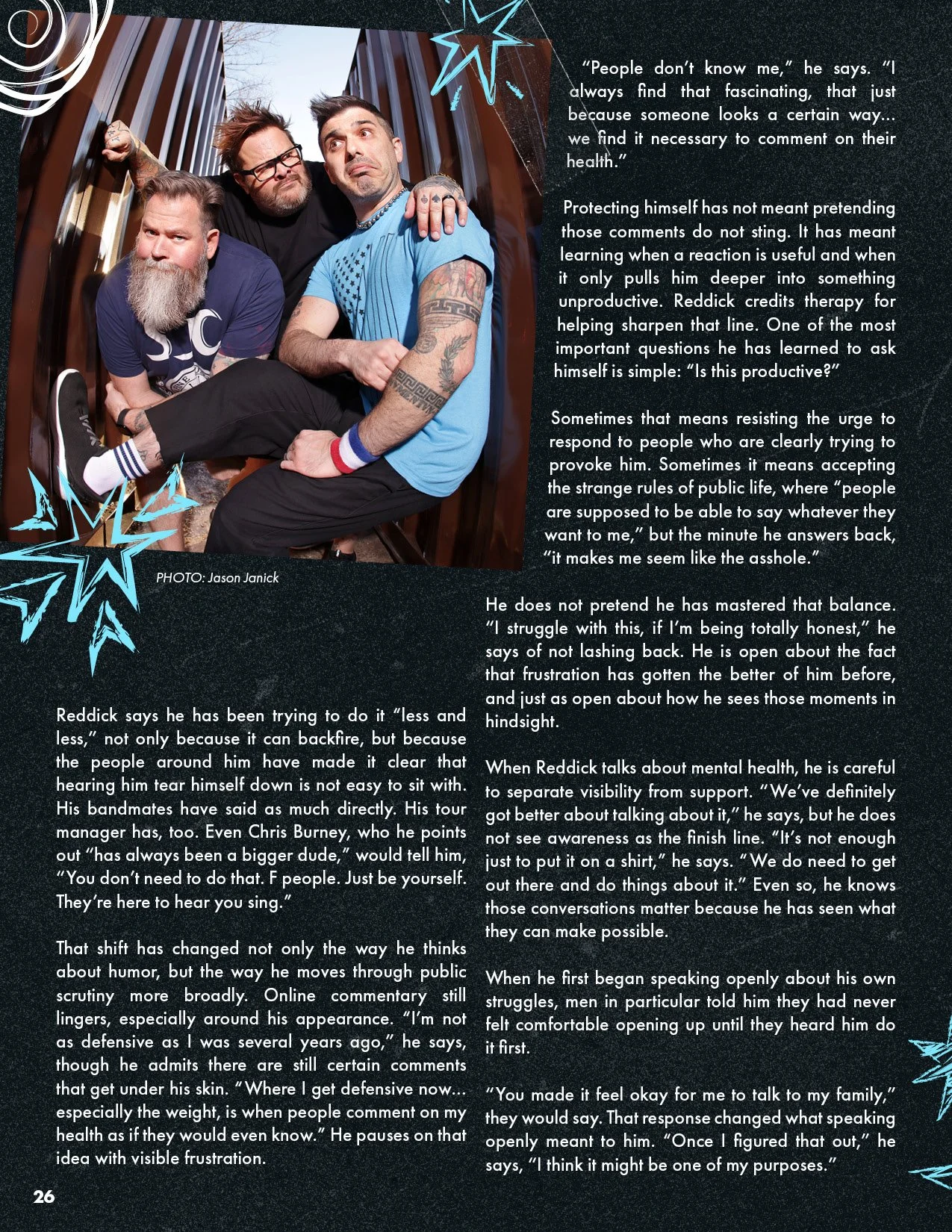
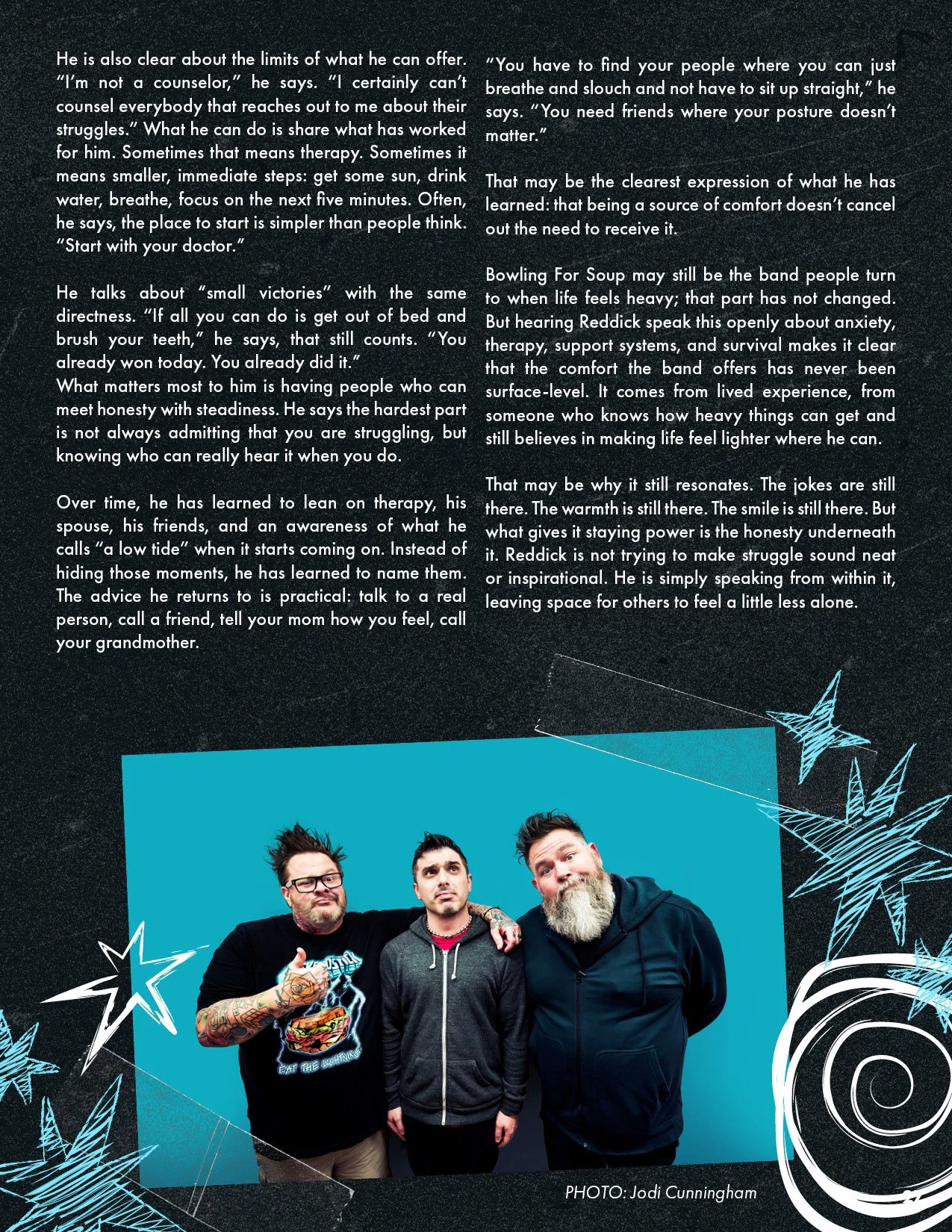
For a lot of people, Bowling For Soup has never been just a band. They are comfort. They are familiar. They are something people return to when they need music that still feels fun and light. Over the years, that role has become part of the band’s identity, and singer Jaret Reddick knows it. “I think I sort of figured out that that’s what we were early on,” he says. While other bands from the same scene evolved in more dramatic or heavier directions, Reddick realized Bowling For Soup had already found its place. “We weren’t going to be one of those bands,” he says. “We were already doing what it is that we do. It’s our niche.”
He also understands what that niche has become for people. “We’re that band that you listen to at the end of a bad day,” he says. “People know that they can come to us for that smile.” Even when he reflects on more difficult periods in his own life, he does not speak about that role with any distance. He points to their album, Lunch. Drunk. Love., arriving during “a time that was pretty rough for me, life-wise and mental health-wise,” calling it “kind of the beginning of my journey with mental health issues in the first place.” Even then, he describes the record as “pretty lighthearted,” despite what was happening behind the scenes. Even when life felt heavier for him personally, the music still gave people something bright to hold onto.
Onstage, his humor feels easy, part of what has made Bowling For Soup so approachable for decades. Offstage, he talks about it with more complexity. When asked whether humor has ever functioned as armor, he does not hesitate. “Yeah,” he says plainly. “That’s been kind of my whole life.” He traces that instinct back to his youth, saying “laughter was a defense mechanism for me all through childhood,” especially “when things weren’t going great at my house or whatever.” That instinct followed him into adulthood, especially when it came to body image and public scrutiny. “Going totally self-deprecating felt like I was building a wall around me,” he says. “If I say it, and then somebody else says it, then it’s almost like it’ll fall on deaf ears, right? Because it’s just like, I already told that joke.”
“Quite frankly, it still sucks,” he says, recalling a time a stranger repeated one of his own cruel jokes back to him. Moments like that have made the tradeoff in self-deprecation harder to ignore. What once felt like protection now looks more complicated. He has also learned that those jokes do not just land with strangers. They land on the people closest to him, too. Reddick says he has been trying to do it “less and less,” not only because it can backfire, but because the people around him have made it clear that hearing him tear himself down is not easy to sit with. His bandmates have said as much directly. His tour manager has, too. Even Chris Burney, who he points out “has always been a bigger dude,” would tell him, “You don’t need to do that. F people. Just be yourself. They’re here to hear you sing.”
That shift has changed not only the way he thinks about humor, but the way he moves through public scrutiny more broadly. Online commentary still lingers, especially around his appearance. “I’m not as defensive as I was several years ago,” he says, though he admits there are still certain comments that get under his skin. “Where I get defensive now… especially the weight, is when people comment on my health as if they would even know.” He pauses on that idea with visible frustration. “People don’t know me,” he says. “I always find that fascinating, that just because someone looks a certain way… we find it necessary to comment on their health.” Protecting himself has not meant pretending those comments do not sting. It has meant learning when a reaction is useful and when it only pulls him deeper into something unproductive. Reddick credits therapy for helping sharpen that line. One of the most important questions he has learned to ask himself is simple: “Is this productive?”
Sometimes that means resisting the urge to respond to people who are clearly trying to provoke him. Sometimes it means accepting the strange rules of public life, where “people are supposed to be able to say whatever they want to me,” but the minute he answers back, “it makes me seem like the asshole.” He does not pretend he has mastered that balance. “I struggle with this, if I’m being totally honest,” he says of not lashing back. He is open about the fact that frustration has gotten the better of him before, and just as open about how he sees those moments in hindsight.
When Reddick talks about mental health, he is careful to separate visibility from support. “We’ve definitely got better about talking about it,” he says, but he does not see awareness as the finish line. “It’s not enough just to put it on a shirt,” he says. “We do need to get out there and do things about it.” Even so, he knows those conversations matter because he has seen what they can make possible. When he first began speaking openly about his own struggles, men in particular told him they had never felt comfortable opening up until they heard him do it first.
You made it feel okay for me to talk to my family,” they would say. That response changed what speaking openly meant to him. “Once I figured that out,” he says, “I think it might be one of my purposes.”
He is also clear about the limits of what he can offer. “I’m not a counselor,” he says. “I certainly can’t counsel everybody that reaches out to me about their struggles.” What he can do is share what has worked for him. Sometimes that means therapy. Sometimes it means smaller, immediate steps: get some sun, drink water, breathe, focus on the next five minutes. Often, he says, the place to start is simpler than people think. “Start with your doctor.”
He talks about “small victories” with the same directness. “If all you can do is get out of bed and brush your teeth,” he says, that still counts. “You already won today. You already did it.” What matters most to him is having people who can meet honesty with steadiness. He says the hardest part is not always admitting that you are struggling, but knowing who can really hear it when you do. Over time, he has learned to lean on therapy, his spouse, his friends, and an awareness of what he calls “a low tide” when it starts coming on. Instead of hiding those moments, he has learned to name them. The advice he returns to is practical: talk to a real person, call a friend, tell your mom how you feel, call your grandmother.
“You have to find your people where you can just breathe and slouch and not have to sit up straight,” he says. “You need friends where your posture doesn’t matter.”
That may be the clearest expression of what he has learned: that being a source of comfort doesn’t cancel out the need to receive it. Bowling For Soup may still be the band people turn to when life feels heavy; that part has not changed. But hearing Reddick speak this openly about anxiety, therapy, support systems, and survival makes it clear that the comfort the band offers has never been surface-level. It comes from lived experience, from someone who knows how heavy things can get and still believes in making life feel lighter where he can. That may be why it still resonates. The jokes are still there. The warmth is still there. The smile is still there. But what gives it staying power is the honesty underneath it. Reddick is not trying to make struggle sound neat or inspirational. He is simply speaking from within it, leaving space for others to feel a little less alone.