
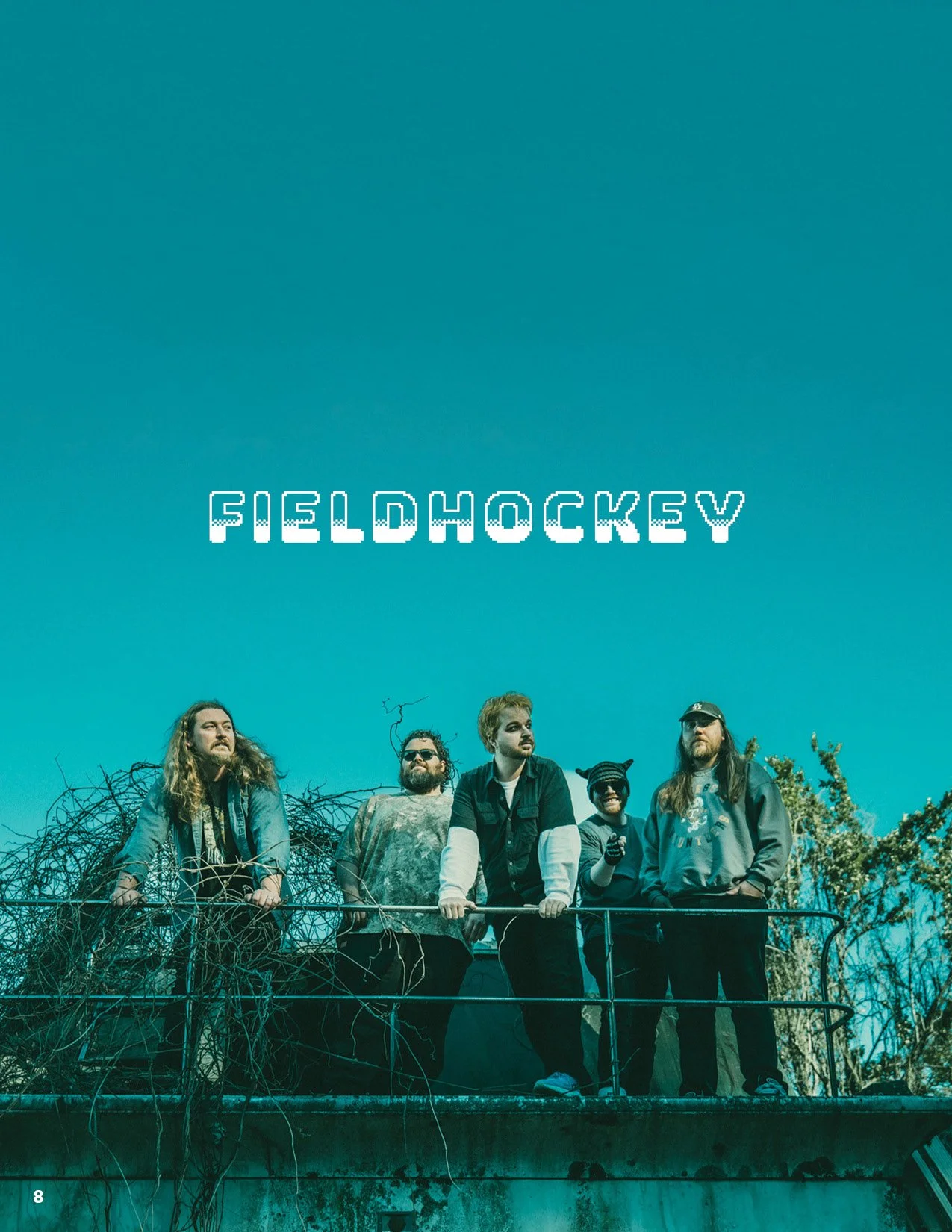
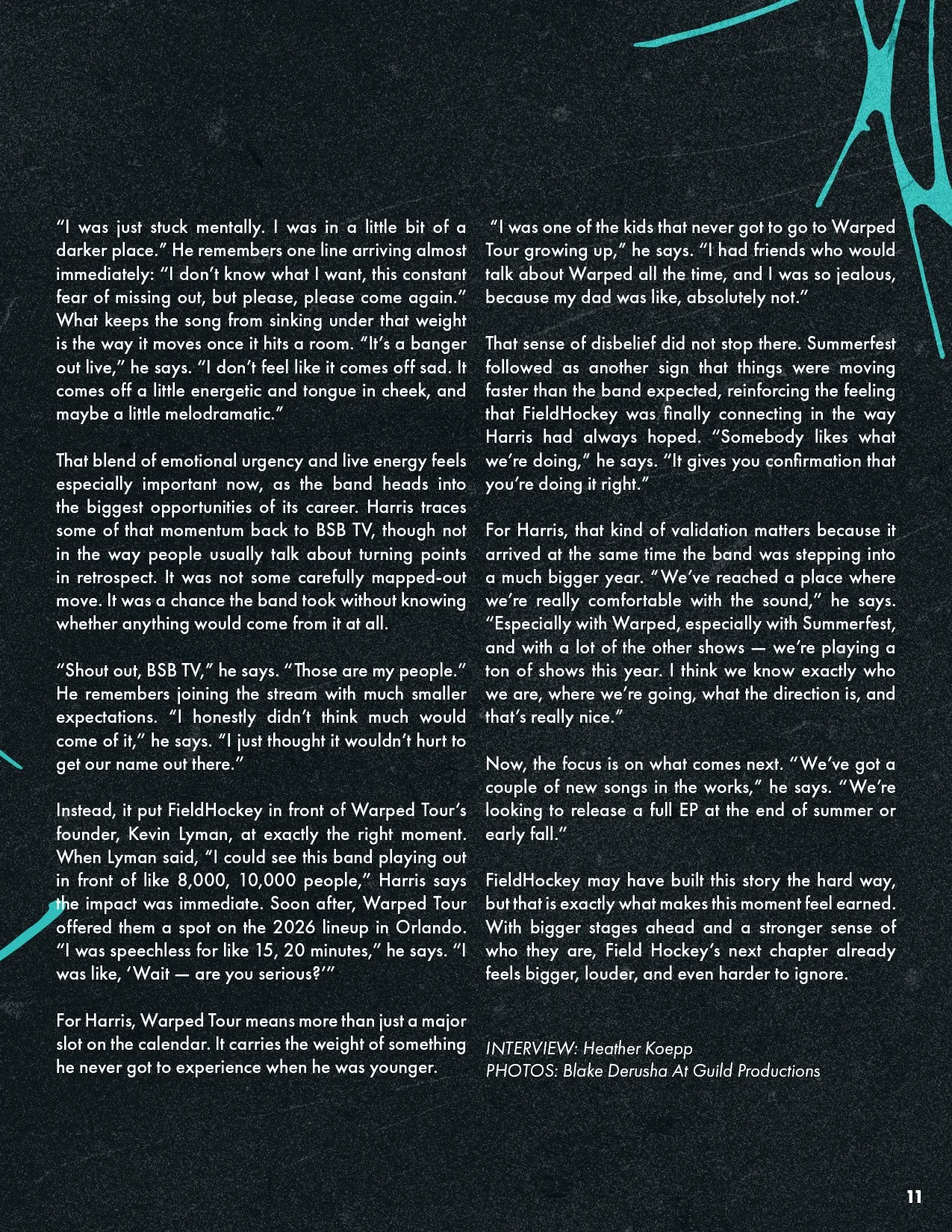
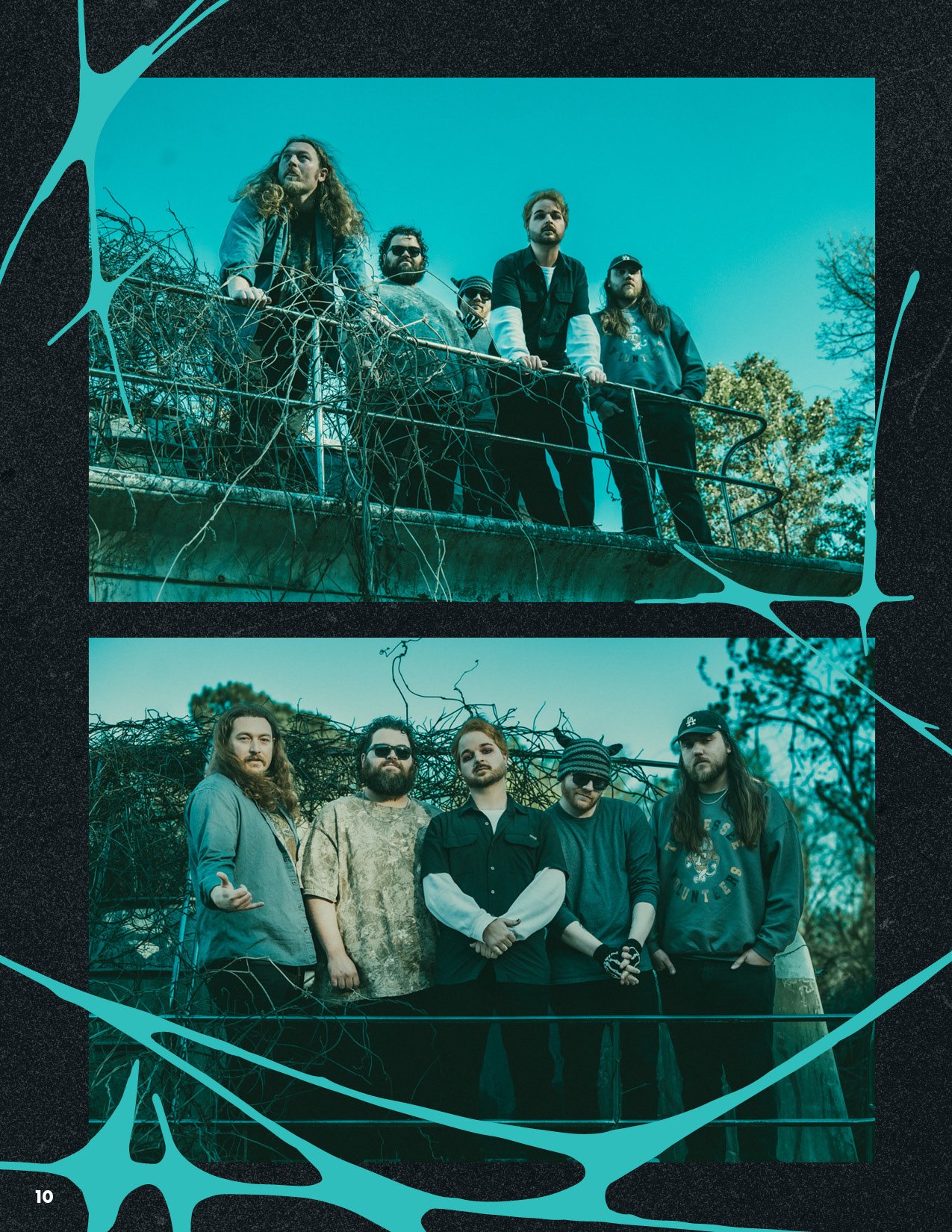
FieldHockey is not one of those bands with a neat origin story. Their path here is messier than that. It involves grimy bars, forgotten lyrics, lineup changes, broken sewer lines, and a frontman who once lost a tooth in the pit at his own show. Somehow, all of it makes perfect sense for a band now stepping into the biggest year of their career.
“We rehearsed, like, three to four times a week,” frontman Enon Harris says, tracing it back to late 2019. “The second week, actually, the original guitarist quit, and so I forced myself to learn how to play guitar, and I knew, like, three chords.” That was enough to get things moving. Within weeks, the band had songs, an EP in mind, and their first show lined up at Ziggy’s in Chattanooga. It was exactly the kind of rough-around-the-edges start Harris now laughs about. “Small, grimy,” he says. “You never know if there’s alcohol on the floor or somebody got sick everywhere.” It was not polished, but it was a beginning.
That same barely-held-together energy runs through much of FieldHockey’s early story. They played tiny bars, birthday bashes in fields, and whatever else they could get. But like a lot of young bands, they eventually hit the point where enthusiasm alone was not enough to keep things steady. There were lineup changes, time apart, and moments when the band's future felt unclear. Harris moved to Myrtle Beach, which only made everything harder logistically, and for a while, it seemed like the project might end before it had fully become what it was meant to be.
“We thought it was over,” he says.
Instead, the band kept rebuilding until the right version finally came together. A real shift came when two guitarists, Michael Avakian and Jake Hixson, arrived for the audition at the same time, and the chemistry was immediate. “We auditioned both of them, not knowing they were both going to be there,” Harris says. “They meshed so well.” That changed the band. Harris stepped back from the guitar and fully into the frontman role. “I came off guitar because I’m like, ‘You guys are phenomenal. You guys are great. I don’t need to do anything. I’m just gonna scream at people.’”
Even then, FieldHockey had not yet fully settled into its identity. For a while, they considered moving in a heavier direction. Releasing songs like “Ecdysis” and later bringing in Left to Suffer’s Taylor Barber for a feature made that version of the band feel possible. “We thought we were going to be heavy,” Harris says. “We were like, yeah, we’re metalcore now.” But the more they played, the clearer it became that the fit was not quite right. “It doesn’t suit me as a vocalist,” he says. “I can’t do that well enough for an hour-long show.”
What emerged instead was something far more natural. Harris points to the bands he grew up on — “The Used, Taking Back Sunday” — as a better reflection of what he had been reaching for all along. That emotional, melodic pull feels central to the band now, and he sees “Common Trope” as one of the clearest examples of that shift. Harris remembers driving through Myrtle Beach with the riff on repeat, writing in the notebook he keeps in the car as the song slowly took shape. The riff was familiar for a reason: it had grown out of an older song idea Harris had once written in a completely different context. But in FieldHockey’s hands, it became something sharper, bigger, and far more aligned with the band they were becoming. “It’s such a perfect song to meld everything together,” he says. “For the longest time, it was my favorite.”
Where “Common Trope” feels like a song about the band coming into focus, “Mazes” offers a window into the headspace underneath it. “I write a lot in the moment,” Harris says. “I was just stuck mentally. I was in a little bit of a darker place.” He remembers one line arriving almost immediately: “I don’t know what I want, this constant fear of missing out, but please, please come again.” What keeps the song from sinking under that weight is the way it moves once it hits a room. “It’s a banger out live,” he says. “I don’t feel like it comes off sad. It comes off a little energetic and tongue in cheek, and maybe a little melodramatic.”
That blend of emotional urgency and live energy feels especially important now, as the band heads into the biggest opportunities of its career. Harris traces some of that momentum back to BSB TV, though not in the way people usually talk about turning points in retrospect. It was not some carefully mapped-out move. It was a chance the band took without knowing whether anything would come from it at all.
“Shout out, BSB TV,” he says. “Those are my people.” He remembers joining the stream with much smaller expectations. “I honestly didn’t think much would come of it,” he says. “I just thought it wouldn’t hurt to get our name out there.”
“Instead, it put FieldHockey in front of Warped Tour’s founder, Kevin Lyman, at exactly the right moment. When Lyman said, “I could see this band playing out in front of like 8,000, 10,000 people,” Harris says the impact was immediate. Soon after, Warped Tour offered them a spot on the 2026 lineup in Orlando. “I was speechless for like 15, 20 minutes,” he says. “I was like, ‘Wait — are you serious?’”
For Harris, Warped Tour means more than just a major slot on the calendar. It carries the weight of something he never got to experience when he was younger. “I was one of the kids that never got to go to Warped Tour growing up,” he says. “I had friends who would talk about Warped all the time, and I was so jealous, because my dad was like, absolutely not.” That sense of disbelief did not stop there. Summerfest followed as another sign that things were moving faster than the band expected, reinforcing the feeling that FieldHockey was finally connecting in the way Harris had always hoped. “Somebody likes what we’re doing,” he says. “It gives you confirmation that you’re doing it right.” For Harris, that kind of validation matters because it arrived at the same time the band was stepping into a much bigger year. “We’ve reached a place where we’re really comfortable with the sound,” he says. “Especially with Warped, especially with Summerfest, and with a lot of the other shows — we’re playing a ton of shows this year. I think we know exactly who we are, where we’re going, what the direction is, and that’s really nice.”
Now, the focus is on what comes next. “We’ve got a couple of new songs in the works,” he says. “We’re looking to release a full EP at the end of summer or early fall.”FieldHockey may have built this story the hard way, but that is exactly what makes this moment feel earned. With bigger stages ahead and a stronger sense of who they are, Field Hockey’s next chapter already feels bigger, louder, and even harder to ignore.