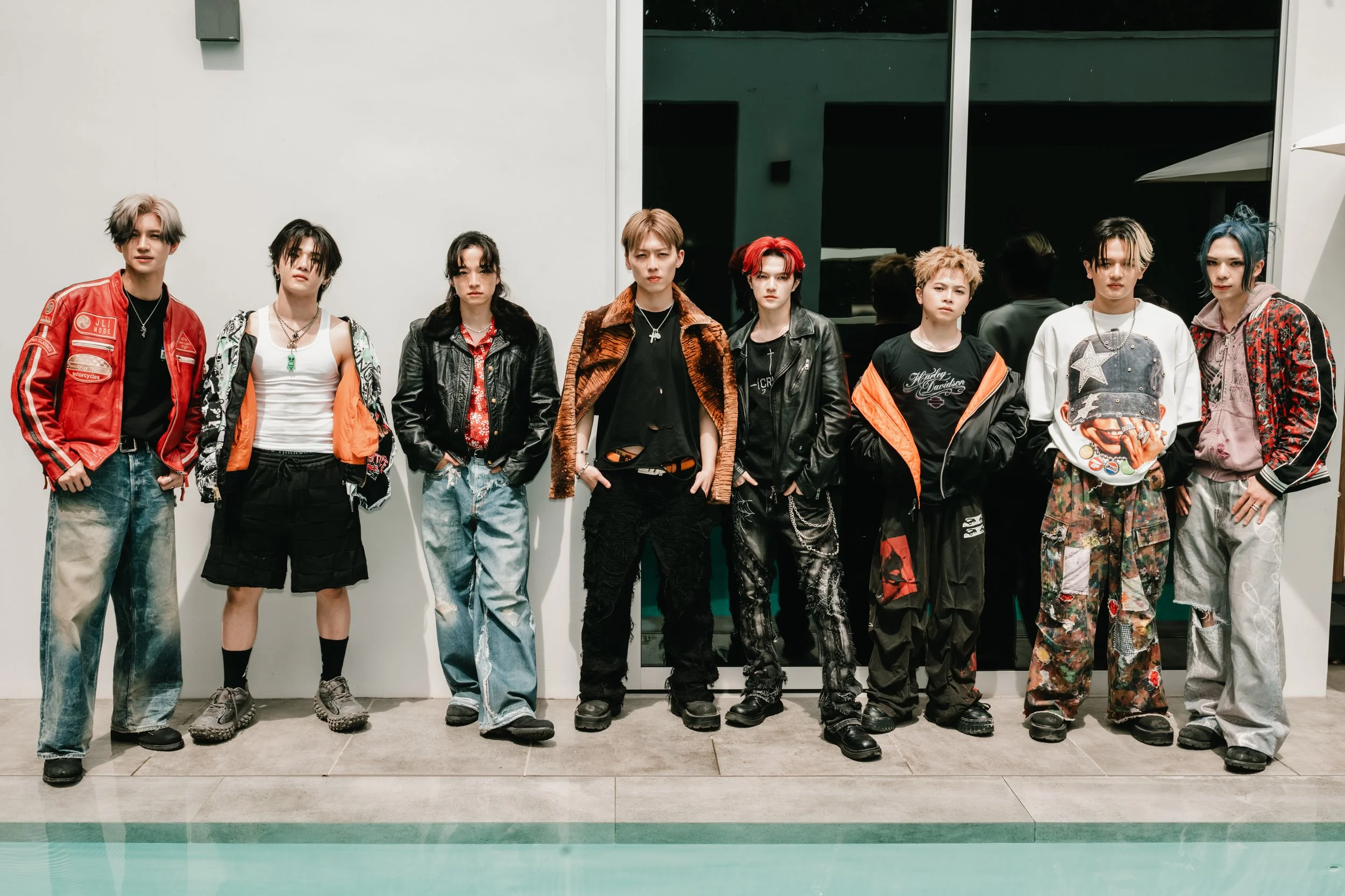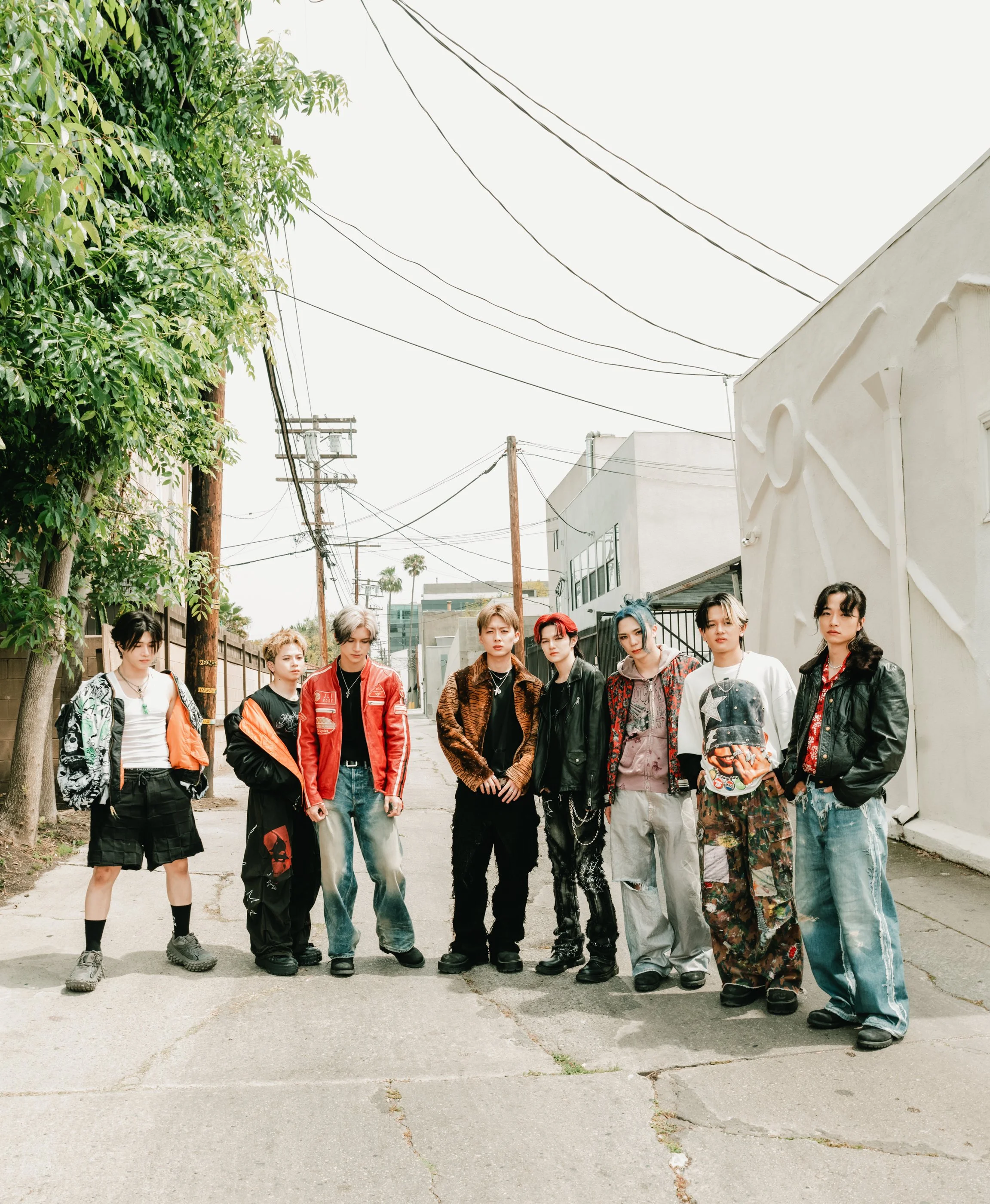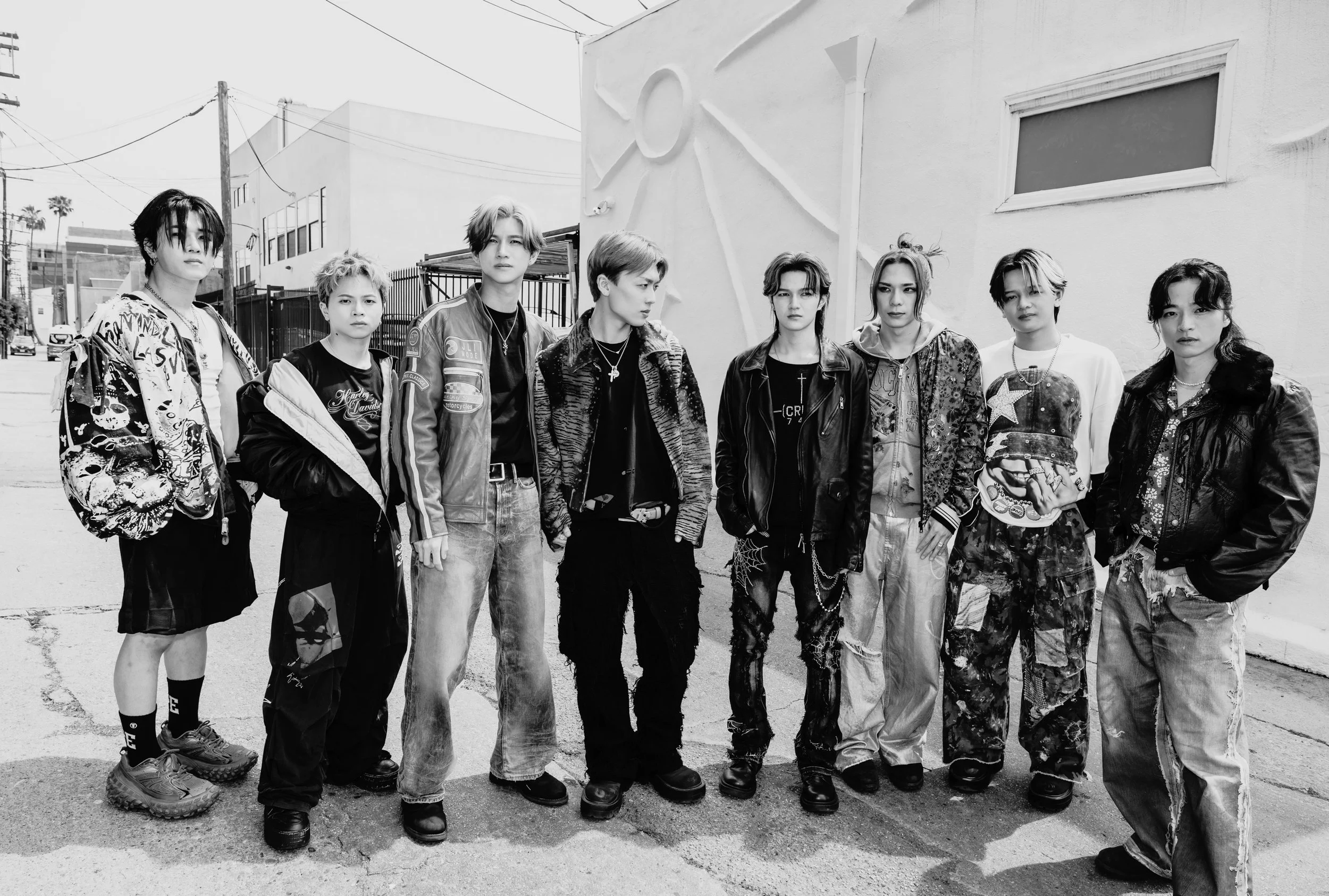
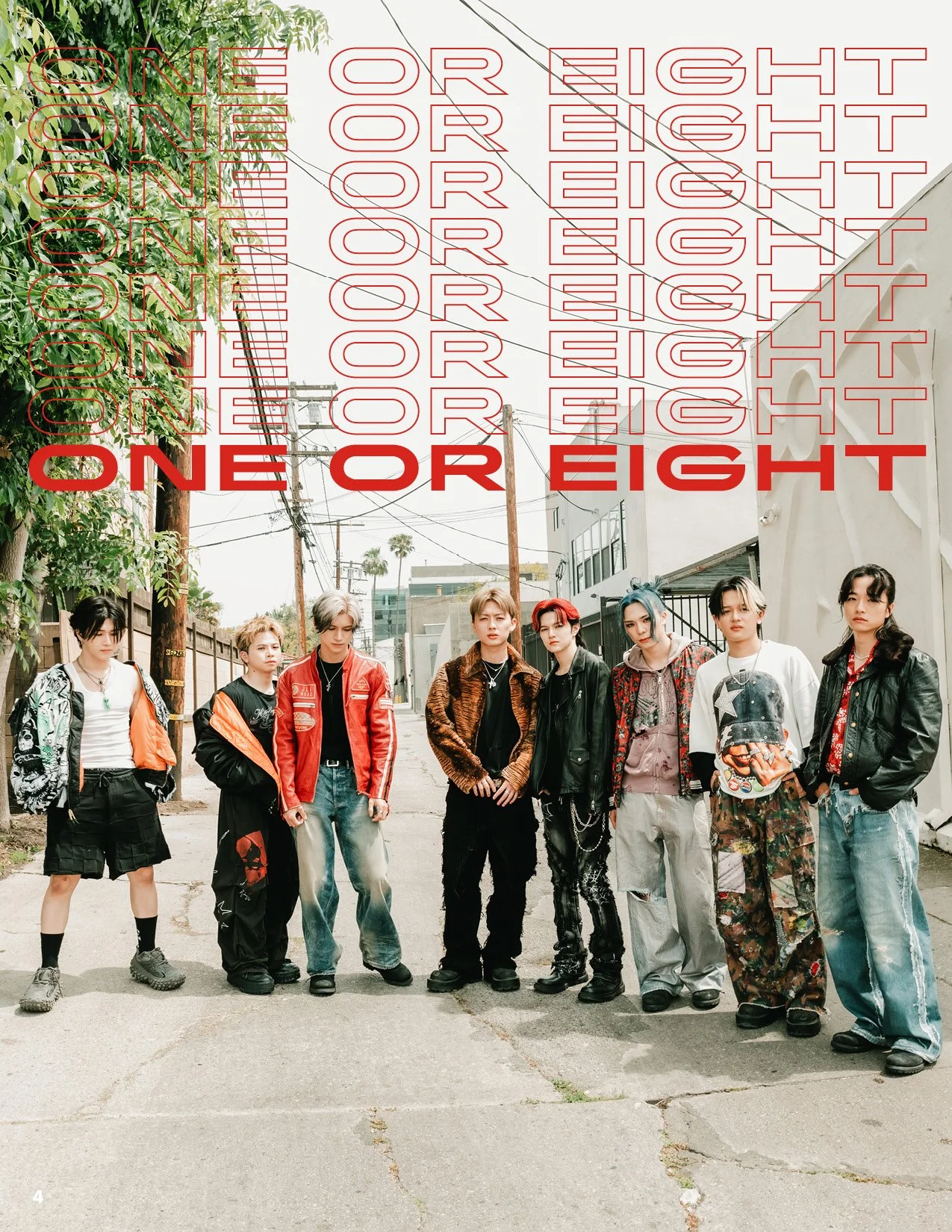


ONE OR EIGHT is not a name made for hesitation. Derived from the Japanese phrase ichi ka bachi ka, meaning “all or nothing,” the eight-member Japanese group embodies that spirit in the way it moves. MIZUKI, NEO, REIA, RYOTA, SOUMA, TAKERU, TSUBASA, and YUGA are creating a project where Japanese identity, global pop, bilingual lyrics, and live performances all come together.
ONE OR EIGHT debuted officially in August 2024 with “Don’t Tell Nobody,” a Ryan Tedder-produced single that hit No. 1 on Billboard Japan’s Heatseekers Songs chart. Their journey has been swift: “KAWASAKI” with Big Sean, “DSTM,” which officially samples Rihanna’s “Don’t Stop the Music,” and now their first mini album, GATHER, led by “TOKYO DRIFT.”
ONE OR EIGHT’s story isn't just about how far their music can go. It’s about what the group refuses to leave behind. On GATHER, that becomes the focus: the Japanese influences, the mix of English and Japanese lyrics, the eight personalities, the trust behind their performance, and the growing sense that ONE OR EIGHT are no longer just stepping into a world built for them. They are starting to build it themselves.
For MIZUKI, that reach is already visible in places far from home.
“Even in places far away from Japan, there are so many people discovering us through our music,” he says.
TAKERU remembers feeling it during the GATHER tour.“It’s incredibly moving to know that people on the other side of the world know our songs and enjoy the music together with us,” he says. “Being able to communicate through music beyond language barriers is something truly special.”
For ONE OR EIGHT, the overseas response has made the group’s purpose feel more focused. The songs travel across languages, but they don’t leave their origins behind. Japanese culture isn’t something the group needs to translate out of their work. It’s part of what shapes their music. For REIA, that idea runs through GATHER. Reimagining modern Japanese style isn’t about adding culture on top of the music later. It’s embedded in the songs, the visuals, and the way the group performs. “One of our goals is to share Japanese culture with the world,” REIA says. “That’s why we try to include elements of Japanese culture in our lyrics and find ways to express Japan through our work.”
On the GATHER tour, that idea became physical. ONE OR EIGHT introduced a dance segment for the first time, using sounds and choreography inspired by Japanese imagery. It gave the group another way to express who they are without needing to explain. YUGA sees the project as a sign of how much ONE OR EIGHT has already accomplished, from their debut song “Don’t Tell Nobody” to “TOKYO DRIFT.” The latter has become a clear example of the group’s direction: familiar enough to hit immediately, but specific enough to be uniquely theirs.
NEO calls “TOKYO DRIFT” the first song that truly captured ONE OR EIGHT’s identity. “It also feels like a celebration of Japanese culture in a modern way,” he says. TAKERU understands the pull of that song from his own memory. He has known the intro since he was around 10 years old, and that familiarity gives the track a different kind of energy when it reaches the stage.
“I feel it’s the kind of track that can get everyone excited regardless of age,” he says. The song gives ONE OR EIGHT a shared starting point with the crowd. From there, the group’s live show becomes less about proving who they are and more about drawing people in. That has become especially important as the group introduces GATHER to new audiences. Their first U.S. and South America tour is a big step, but the members talk about it less as a milestone and more as a chance to connect with people face-to-face.
YUGA says speaking to fans in the local language during MC sections helps build a stronger connection. TSUBASA highlights parts of the show that can only happen in the room, including stage elements and performances shaped by the members’ behind-the-scenes involvement. For MIZUKI, overseas shows have changed how he perceives their music. “No matter which country we visited, seeing 1DERZ singing and dancing along made me feel more confident, and honestly, it made me really happy,” he says.
RYOTA feels that difference as soon as the group steps into a city like Los Angeles. The crowd, the energy, and the response all influence how ONE OR EIGHT approaches the stage.
“Some moments work better with a cleaner style, while others are more exciting when expressed in a rougher, freer way,” he says. “The reactions vary a lot, so we study those differences and adjust our performances accordingly.”
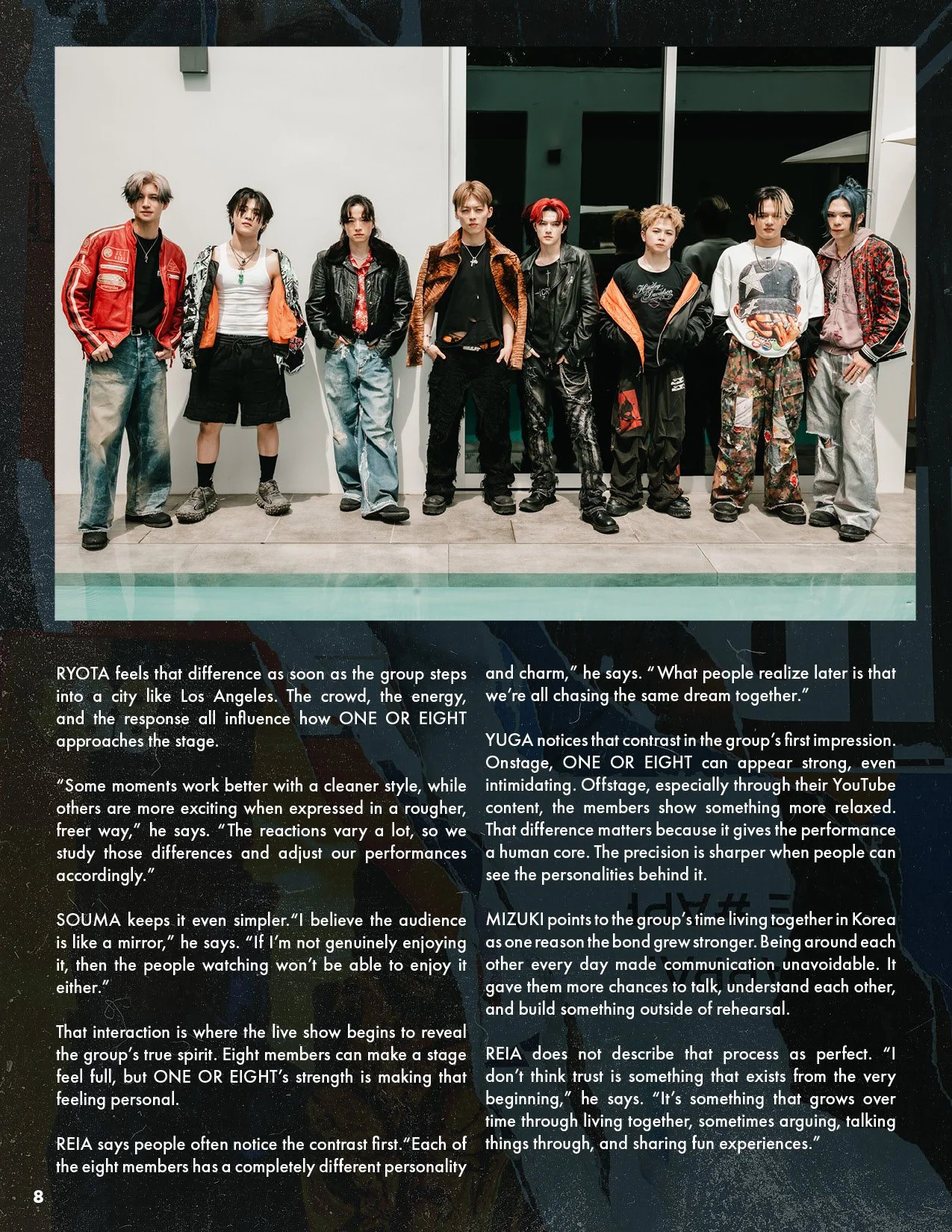
SOUMA keeps it even simpler.“I believe the audience is like a mirror,” he says. “If I’m not genuinely enjoying it, then the people watching won’t be able to enjoy it either.” That interaction is where the live show begins to reveal the group’s true spirit. Eight members can make a stage feel full, but ONE OR EIGHT’s strength is making that feeling personal. REIA says people often notice the contrast first.“Each of the eight members has a completely different personality and charm,” he says. “What people realize later is that we’re all chasing the same dream together.”
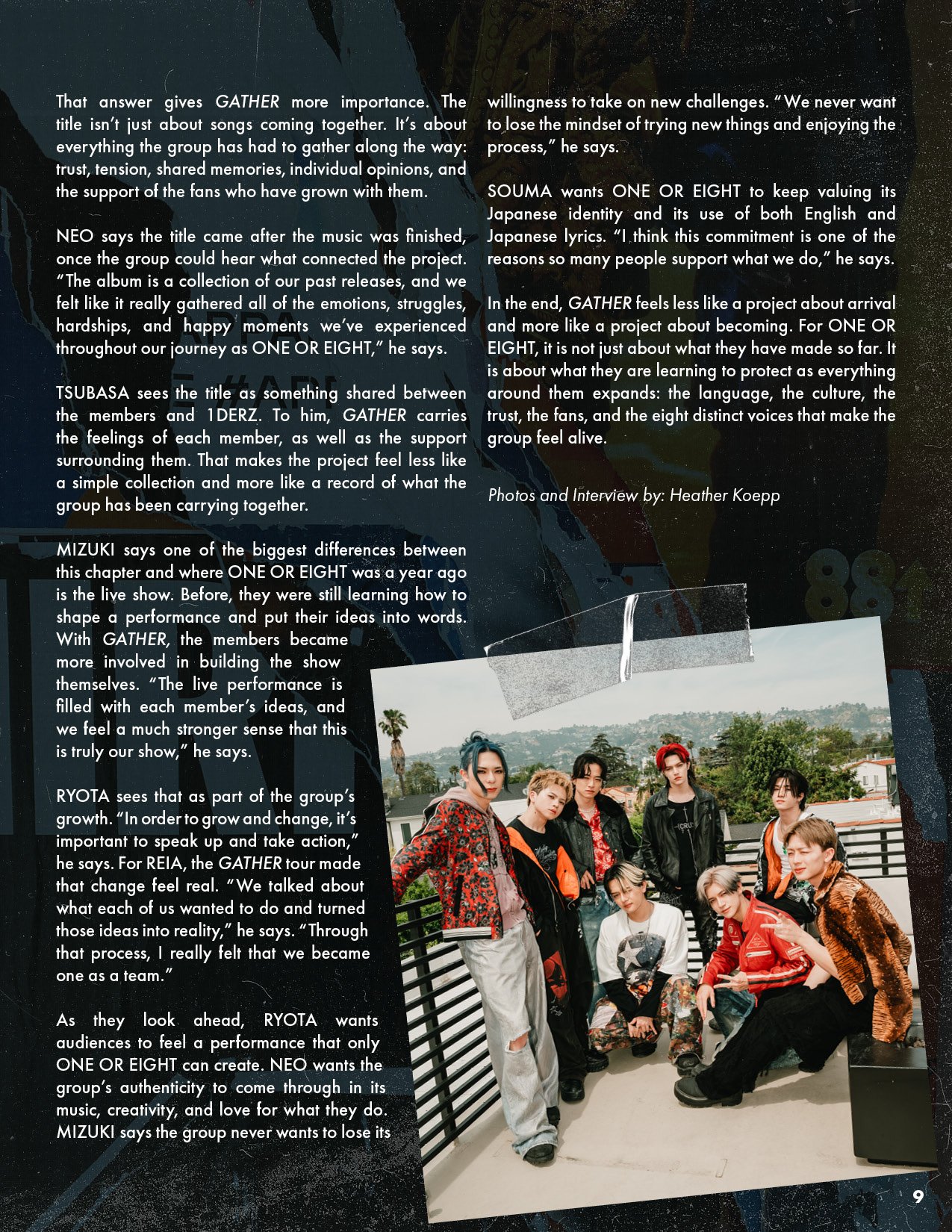
YUGA notices the contrast in the group’s first impression. Onstage, ONE OR EIGHT can appear strong, even intimidating. Offstage, especially through their YouTube content, the members show something more relaxed. That difference matters because it gives the performance a human core. The precision is sharper when people can see the personalities behind it. MIZUKI points to the group’s time living together in Korea as one reason the bond grew stronger. Being around each other every day made communication unavoidable. It gave them more chances to talk, understand each other, and build something outside of rehearsal.
REIA does not describe that process as perfect. “I don’t think trust is something that exists from the very beginning,” he says. “It’s something that grows over time through living together, sometimes arguing, talking things through, and sharing fun experiences.”
That answer gives GATHER more importance. The title isn’t just about songs coming together. It’s about everything the group has had to gather along the way: trust, tension, shared memories, individual opinions, and the support of the fans who have grown with them.
NEO says the title came after the music was finished, once the group could hear what connected the project. “The album is a collection of our past releases, and we felt like it really gathered all of the emotions, struggles, hardships, and happy moments we’ve experienced throughout our journey as ONE OR EIGHT,” he says.
TSUBASA sees the title as something shared between the members and 1DERZ. To him, GATHER carries the feelings of each member, as well as the support surrounding them. That makes the project feel less like a simple collection and more like a record of what the group has been carrying together.
MIZUKI says one of the biggest differences between this chapter and where ONE OR EIGHT was a year ago is the live show. Before, they were still learning how to shape a performance and put their ideas into words. With GATHER, the members became more involved in building the show themselves. “The live performance is filled with each member’s ideas, and we feel a much stronger sense that this is truly our show,” he says.
RYOTA sees that as part of the group’s growth. “In order to grow and change, it’s important to speak up and take action,” he says. For REIA, the GATHER tour made that change feel real. “We talked about what each of us wanted to do and turned those ideas into reality,” he says. “Through that process, I really felt that we became one as a team.”
As they look ahead, RYOTA wants audiences to feel a performance that only ONE OR EIGHT can create. NEO wants the group’s authenticity to come through in its music, creativity, and love for what they do. MIZUKI says the group never wants to lose its willingness to take on new challenges. “We never want to lose the mindset of trying new things and enjoying the process,” he says. SOUMA wants ONE OR EIGHT to keep valuing its Japanese identity and its use of both English and Japanese lyrics. "I think this commitment is one of the reasons so many people support what we do,” he says.
In the end, GATHER feels less like a project about arrival and more like a project about becoming. For ONE OR EIGHT, it is not just about what they have made so far. It is about what they are learning to protect as everything around them expands: the language, the culture, the trust, the fans, and the eight distinct voices that make the group feel alive.